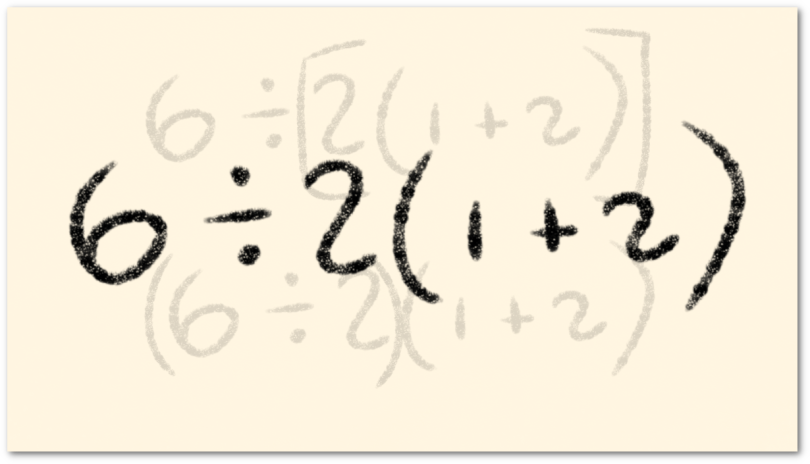
In 2019 a debate went viral, discussing on what is the result of the operation 8÷2(2+2), I thought that it had been forgotten and that the situation had already been clarified. However, it was reborn on the infamous 2020 as 6÷2(1+2).
It is necessary to understand that when considering mixed operations, there is an established order among the operations. First all the products must be made, then all the divisions, then all the additions and finally all the subtractions. Also consider that if there are signs of grouping you must first solve the contents between parentheses ( ), then brackets [ ] and then braces { }; you must make the operations that are within them considering the original hierarchy between operations. This is what people call BODMAS.
Anuncios
Does calculators lie?
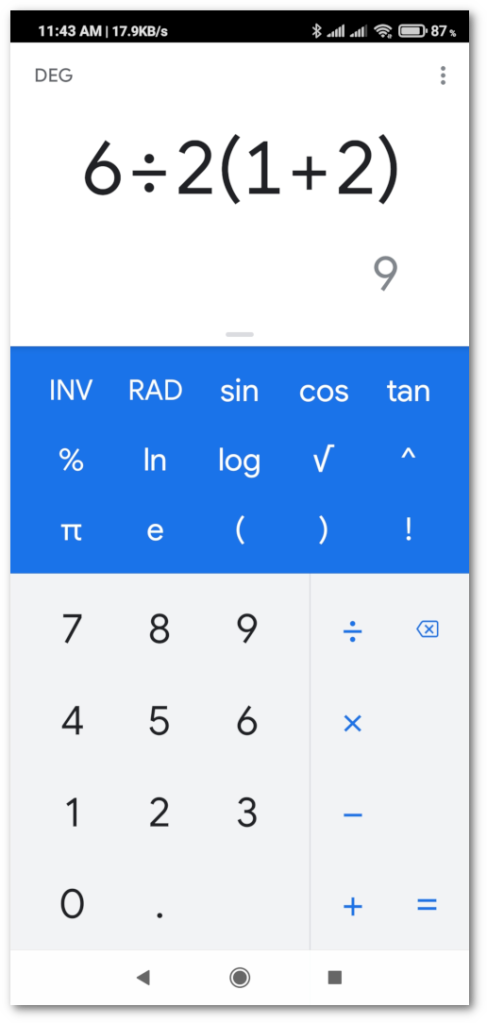
When calculating this operation in a calculator, the results will differ depending on how they have been programmed because some have been programmed to prioritize the order of operations and others have been programmed to prioritize the order of appearance of the operations.
Anuncios
Write it better…
In my opinion, the problem with that specific case is that the person who originally raised it does not have the slightest idea of how to use the grouping signs because when operations between numbers are proposed, they always come from a real problem, so that kind of problems will always be well proposed if they are written correctly. Ambiguity in mathematics should have no place.
This operation defined as it is, is like asking a question without question marks, commas, colons or semicolons.
Anuncios
How to propose the problem?
Case 1
Suppose that you work for a party agency and at a party you have been asked to distribute six pieces of cake to a pair of children, this situation is described with the operation 6÷2. Suppose furthermore that you have to do this twice more, then this situation is described with the following operation (6÷2)×2. If again you are told to do this one more times, then at the end you will describe this with the following operation
(6÷2)×(2+1) = 3×3 = 9
This means that in the end you will have to distribute 9 pieces of cake.
Case 2
Suppose again that you work at a party agency and you have been given six pieces of cake to distribute to a pair children, this situation is described with operation 6÷2. However, you are being told that now it is not a pair of children but rather two pairs of children, this situation is described with the operation 6÷[2×2]. Finally, you are told that one more pair of children have arrived, so in the end you will describe this with the following operation
6÷[2×(2+1)] = 6÷[2×3] = 6÷6 = 1
This means that at the end you will have to give a piece of cake to each child.
In conclusion…
Considering these two cases, we notice that each one has its own approach and interpretation. Always specifying which operations have to be grouped together and always specifying which operations should be carried out first.
In 2019 a debate went viral, discussing on what is the result of the operation 8÷2(2+2), I thought that it had been forgotten and that the situation had already been clarified. However, I was asked what the result of this operation was, quoting me on a tweet, and even today, the people who responded are still deciding between 1 and 16.
It is necessary to understand that when considering mixed operations, there is an established order among the operations. First all the products must be made, then all the divisions, then all the additions and finally all the subtractions. Also consider that if there are signs of grouping you must first solve the contents between parentheses (), then brackets [] and then braces {}; you must make the operations that are within them considering the original hierarchy between operations. This is what people call BODMAS.
Anuncios
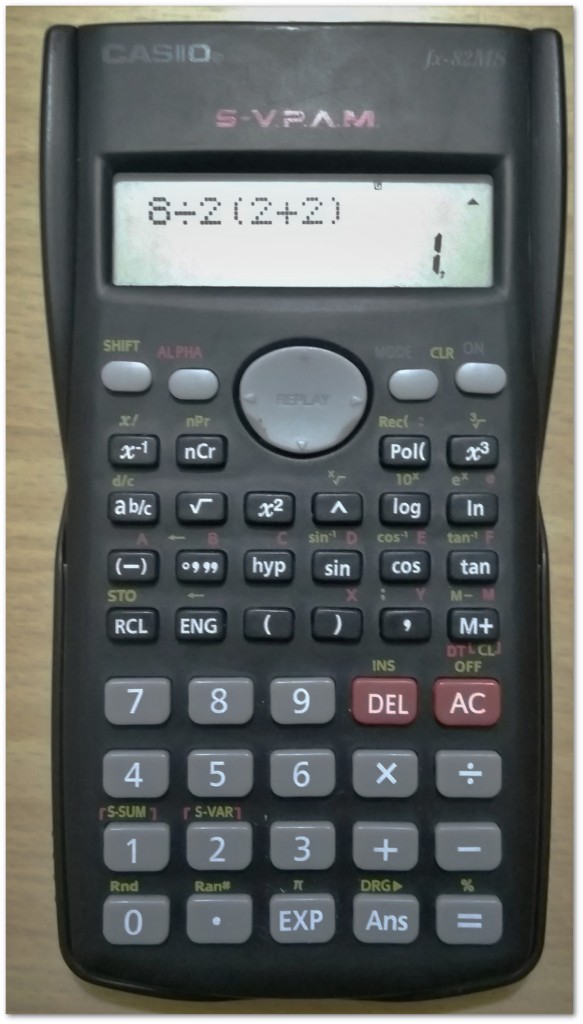
Does calculators lie?
Android Calculator.
«CASIIO» calculator bought at the Chinese Store.
When calculating this operation in a calculator, the results will differ depending on how they have been programmed because some have been programmed to prioritize the hierarchy between operations and others have been programmed to prioritize the order of appearance of the operations.
Anuncios
Write it better…
In my opinion, the problem with that specific case is that the person who originally raised it does not have the slightest idea of how to use the grouping signs because when operations between numbers are proposed, they always come from a real problem, so that kind of problems will always be well proposed if they are written correctly. Ambiguity in mathematics should have no place.
This operation defined as it is, is like asking a question without question marks, commas, colons or semicolons.
Anuncios
How to propose the problem?
Case 1
Suppose that you work for a party agency and at a party you have been asked to distribute eight pieces of cake to a couple of children, this situation is described with the operation 8÷2. Suppose furthermore that you have to do this twice more, then this situation is described with the following operation (8÷2)×2. If again you are told to do this two more times, then at the end you will describe this with the following operation
(8÷2)×(2+2) = 4×4 = 16
This means that in the end you will have to distribute 16 pieces of cake.
Case 2
Suppose again that you work at a party agency and you have been given eight pieces of cake to distribute to a couple of children, this situation is described with operation 8÷2. However, you are being told that now it is not a pair of children but rather two pairs of children, this situation is described with the operation 8÷(2×2). Finally, you are told that two more pairs of children have arrived, so in the end you will describe this with the following operation
8÷[2×(2+2)] = 8÷[2×4] = 8÷8 = 1
This means that at the end you will have to give a piece of cake to each child.
In conclusion…
Considering these two cases, we notice that each one has its own approach and interpretation. Always specifying which operations have to be grouped together and always specifying which operations should be carried out first.
Si bien hemos podido definir operaciones entre matrices, es posible definir operaciones entre y sobre las filas de una matriz y de igual manera, es posible definir operaciones entre y sobre las columnas de una matriz. Veremos además, que al aplicar estas operaciones, podemos deducir el determinante de la nueva matriz a partir de la matriz original.
También pudiera interesarte
Operaciones elementales por fila
Veamos a continuación cuales son las operaciones que podemos definir sobre y entre las filas de una matriz.
Intercambio de filas de una matriz
Si y son dos filas de una matriz de tamaño , tales que , denotamos el intercambio de estas dos filas usando la notación y la expresamos de la siguiente manera:
Veamos algunos ejemplos para ilustrar esta idea con más claridad.
Ejemplos
Ejemplo 1
Consideremos una matriz de tamaño e intercambiemos la fila por la fila , entonces,
Ejemplo 2
Consideremos una matriz de tamaño e intercambiemos la fila por la fila , entonces,
Ejemplo 3
Consideremos una matriz de tamaño e intercambiemos la fila por la fila , entonces,
Ejemplo 4
Consideremos una matriz de tamaño e intercambiemos la fila por la fila , entonces,
Si te ha parecido útil la información que hemos presentado en totumat y quieres ayudar a mantener este sitio en línea puedes mirar nuestros anuncios publicitarios o donar dinero a través de PayPal.
Suma de filas de una matriz
Si y son dos filas de una matriz de tamaño , tales que . Podemos considerar la fila y sumarle la fila , es decir, sumar los términos correspondientes, para esto usamos la notación y la expresamos de la siguiente manera:
Veamos algunos ejemplos para ilustrar esta idea con más claridad.
Ejemplos
Ejemplo 5
Consideremos una matriz de tamaño y a la fila le sumamos la fila , entonces,
Ejemplo 6
Consideremos una matriz de tamaño y a la fila le sumamos la fila , entonces,
Ejemplo 7
Consideremos una matriz de tamaño y a la fila le sumamos la fila , entonces,
Fe de erratas: El elemento resultante es igual a .
Ejemplo 8
Consideremos una matriz de tamaño y a la fila le sumamos la fila , entonces,
Fe de erratas: El elemento resultante es igual a .
Si te ha parecido útil la información que hemos presentado en totumat y quieres ayudar a mantener este sitio en línea puedes mirar nuestros anuncios publicitarios o donar dinero a través de PayPal.
Multiplicar una fila de una matriz por un escalar
Si es una fila de una matriz de tamaño . Podemos considerar la fila y multiplicarla por un escalar , para esto usamos la notación y la expresamos de la siguiente manera:
Veamos algunos ejemplos para ilustrar esta idea con más claridad.
Ejemplos
Ejemplo 9
Consideremos una matriz de tamaño y multipliquemos la fila por el escalar , entonces,
Ejemplo 10
Consideremos una matriz de tamaño y multipliquemos la fila por el escalar , entonces,
Ejemplo 11
Consideremos una matriz de tamaño y multipliquemos la fila por el escalar , entonces,
Ejemplo 12
Consideremos una matriz de tamaño y multipliquemos la fila por el escalar , entonces,
Si te ha parecido útil la información que hemos presentado en totumat y quieres ayudar a mantener este sitio en línea puedes mirar nuestros anuncios publicitarios o donar dinero a través de PayPal.
Sumar una fila de una matriz multiplicada por un escalar
Finalmente, veremos una operación elemental que de cierta forma mezcla efectúa varias operaciones al mismo tiempo. Si y son dos filas de una matriz de tamaño , tales que . Podemos considerar la fila y sumarle la fila multiplicada por un escalar , para esto usamos la notación y la expresamos de la siguiente manera:
Veamos algunos ejemplos para ilustrar esta idea con más claridad.
Ejemplos
Ejemplo 13
Consideremos una matriz de tamaño y a la fila le sumamos la fila multiplicada por , entonces,
Ejemplo 14
Consideremos una matriz de tamaño y a la fila le sumamos la fila multiplicada por , entonces,
Ejemplo 15
Consideremos una matriz de tamaño y a la fila le sumamos la fila multiplicada por , entonces,
Notemos que en este caso estamos definiendo la resta de filas de una matriz.
Ejemplo 16
Consideremos una matriz de tamaño y a la fila le sumamos la fila multiplicada por , entonces,
Si te ha parecido útil la información que hemos presentado en totumat y quieres ayudar a mantener este sitio en línea puedes mirar nuestros anuncios publicitarios o donar dinero a través de PayPal.
Matrices equivalentes por filas
Una vez que se ha hecho una operación elemental por fila a una matriz, se pueden seguir haciendo operaciones elementales por fila a las matrices resultantes de forma sucesiva. Diremos que si una matriz se obtiene a partir de una matriz a través de una sucesión finita de operaciones elementales por filas, entonces diremos que las matrices y son matrices equivalentes por filas y esta relación la denotaremos por
Veamos algunos ejemplos para ilustrar esta idea con más claridad.
Ejemplo
Consideremos una matriz de tamaño , haciendo operaciones elementales por fila de forma sucesiva, veamos que esta es equivalente a la matriz identidad .
Si te ha parecido útil la información que hemos presentado en totumat y quieres ayudar a mantener este sitio en línea puedes mirar nuestros anuncios publicitarios o donar dinero a través de PayPal.
Operaciones elementales por columna
Veamos a continuación cuales son las operaciones que podemos definir sobre y entre las filas de una matriz.
Intercambio de columnas de una matriz
Si y son dos columnas de una matriz de tamaño , tales que , denotamos el intercambio de estas dos columnas usando la notación y la expresamos de la siguiente manera:
Veamos algunos ejemplos para ilustrar esta idea con más claridad.
Ejemplos
Ejemplo 17
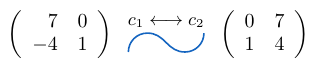
Consideremos una matriz de tamaño e intercambiemos la columna por la columna , entonces,
Ejemplo 18
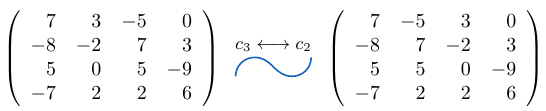
Consideremos una matriz de tamaño e intercambiemos la columna por la columna , entonces,
Ejemplo 19
Consideremos una matriz de tamaño e intercambiemos la columna por la columna , entonces,
Ejemplo 20
Consideremos una matriz de tamaño e intercambiemos la columna por la columna , entonces,
Si te ha parecido útil la información que hemos presentado en totumat y quieres ayudar a mantener este sitio en línea puedes mirar nuestros anuncios publicitarios o donar dinero a través de PayPal.
Suma de columnas de una matriz
Si y son dos columnas de una matriz de tamaño , tales que . Podemos considerar la columna y sumarle la columna , es decir, sumar los términos correspondientes, para esto usamos la notación y la expresamos de la siguiente manera:
Veamos algunos ejemplos para ilustrar esta idea con más claridad.
Ejemplos
Ejemplo 21
Consideremos una matriz de tamaño y a la columna le sumamos la columna , entonces,
Ejemplo 22
Consideremos una matriz de tamaño y a la columna le sumamos la columna , entonces,
Ejemplo 23
Consideremos una matriz de tamaño y a la columna le sumamos la columna , entonces,
Ejemplo 24
Consideremos una matriz de tamaño y a la columna le sumamos la columna , entonces,
Si te ha parecido útil la información que hemos presentado en totumat y quieres ayudar a mantener este sitio en línea puedes mirar nuestros anuncios publicitarios o donar dinero a través de PayPal.
Multiplicar una columna de una matriz por un escalar
Si es una columna de una matriz de tamaño . Podemos considerar la columna y multiplicarla por un escalar , para esto usamos la notación y la expresamos de la siguiente manera:
Veamos algunos ejemplos para ilustrar esta idea con más claridad.
Ejemplos
Ejemplo 25
Consideremos una matriz de tamaño y multipliquemos la columna por el escalar , entonces,
Ejemplo 26
Consideremos una matriz de tamaño y multipliquemos la columna por el escalar , entonces,
Ejemplo 27
Consideremos una matriz de tamaño y multipliquemos la columna por el escalar , entonces,
Ejemplo 28
Consideremos una matriz de tamaño y multipliquemos la columna por el escalar , entonces,
Si te ha parecido útil la información que hemos presentado en totumat y quieres ayudar a mantener este sitio en línea puedes mirar nuestros anuncios publicitarios o donar dinero a través de PayPal.
Sumar una columna de una matriz multiplicada por un escalar
Finalmente, veremos una operación elemental que de cierta forma mezcla efectúa varias operaciones al mismo tiempo. Si y son dos columnas de una matriz de tamaño , tales que . Podemos considerar la columna y sumarle la columna multiplicada por un escalar , para esto usamos la notación y la expresamos de la siguiente manera:
Veamos algunos ejemplos para ilustrar esta idea con más claridad.
Ejemplos
Ejemplo 29
Consideremos una matriz de tamaño y a la columna le sumamos la columna multiplicada por , entonces,
Ejemplo 30
Consideremos una matriz de tamaño y a la columna le sumamos la columna multiplicada por , entonces,
Ejemplo 31
Consideremos una matriz de tamaño y a la columna le sumamos la columna multiplicada por , entonces,
Notemos que en este caso estamos definiendo la resta de columnas.
Ejemplo 32
Consideremos una matriz de tamaño y a la columna le sumamos la columna multiplicada por , entonces,
Fractions are an alternative way to denote division between two numbers and are generally used to express proportions, for example, to express three-quarters of a quantity we write or to denote half of a cake we simply write . It is possible to represent the fractions graphically to make them easier to understand.
Formally, if we consider two integers and , then we will say that is the numerator of the fraction and is the denominator of the fraction, and so, the division will be represented by the following expression
The number above is called numerator and the number below is called denominator.
Anuncios
Fraction properties
When we work with fractions, we will find very particular expressions that we can identify when we want to simplify mathematical operations. Let’s consider an non-zero integer and see below what these fractions are.
One divided by one equals one. In general, if we consider any non-zero real, the division of this number by itself, is equal to one, then,
.
.
Any integer number can be expressed as the division of itself with one, this information will be useful when we are presented with operations between numbers expressed in fractions and integers.
.
When dividing zero by any non-zero real number, the result will always be the same, zero.
On the contrary, if we take any real number, it cannot be divided by zero because this operation is not defined, that is, division by zero is not defined.
not defined.
Anuncios
The Law of Signs for Fractions
Since fractions represent divisions, we can also establish the law of signs for division, if and are integers such that is non-zero, then
.
.
.
.
The advantage in the use of fractions is that they provide rigidity in the results and thus avoid approximation or rounding errors when making divisions, which is why it is necessary to master the operations of sum, subtraction, multiplication and division between the fractions.
Anuncios
Proper and improper fractions
One way to classify fractions is by considering the size of their numerator and denominator, because these will determine the portion they really represent. If and are two integers such that , we have to
If , we will say that the fraction is is proper, that is, if the numerator is smaller than the denominator.
If , we will say that the fraction is is improper, that is, if the numerator is greater or equal than the denominator.
To clarify this idea, let’s see some examples.
Examples
Example 1
The fraction , is a proper fraction, because its numerator is less than its denominator.
Example 2
The fraction , is an proper fraction, because its numerator is smaller than its denominator.
Example 3
The fraction , is an proper fraction, because its numerator is smaller than its denominator.
Example 4
The fraction , is an proper fraction, because its numerator is smaller than its denominator.
Example 5
The fraction , is an improper fraction, because its numerator is greater than its denominator.
Example 6
The fraction , is an improper fraction, because its numerator is bigger than its denominator.
Example 7
The fraction , is an improper fraction, because its numerator is bigger than its denominator.
Example 8
The fraction , is an improper fraction, because its numerator is bigger than its denominator.
Anuncios
Mixed fractions
When reading a recipe it is common to find measurements for ingredients such as one and a half cup of sugar or, that is why we can find containers with measurements of , , or . This also occurs when buying foods that must be weighed, such as one kilograms and a quarter cheese or three and a half kilograms of meat.
Fractions are ideal to express this type of measurements, they are designed to measure portions, for example, to write a cup and a half you can write which in turn is equal to . However, the way they are written may not present comfort or clarity in practice, that is why the mixed fractions (or mixed numbers) are defined, then, that instead of writing , one writes
In this way, we define mixed fractions to separate the whole part from its non-integer part, the latter usually represented with a fraction of its own. Any mixed fraction can be rewritten as an improper fraction, because if , and are positive integers, then the following mixed fraction
is rewritten as an improper fraction adding with , that is,
Let’s see some examples of how to rewrite mixed fractions.
Anuncios
Examples
Example 9
Rewrite the mixed fraction as an improper fraction.
Example 10
Rewrite the mixed fraction as an improper fraction.
Example 11
Rewrite the mixed fraction as an improper fraction.
Example 12
Rewrite the mixed fraction as an improper fraction.
Example 13
Rewrite the mixed fraction as an improper fraction.
Al estudiar la Ley de Tricotomía en los números reales, pudimos establecer tres tipos de relaciones entre un par de números reales, con las ecuaciones estudiamos la relación que existe cuando dos números eran iguales. Ahora, ¿qué relación existe cuando dos números no son iguales? Cuando dos números no iguales, podemos decir que estos son desiguales. Veamos entonces los tipos de desigualdad que podemos encontrar:
También pudiera interesarte
Tipos de Desigualdades
Mayor que
La desigualdad mayor que se denota con el símbolo y relaciona dos números reales indicando que el primero es mayor que el segundo. Por ejemplo:
, se lee diez es mayor que ocho.
, se lee tres es mayor que menos nueve.
, se lee menos quince es mayor que menos dieciséis.
Mayor o igual que
La desigualdad mayor o igual que se denota con el símbolo y relaciona dos números reales indicando que el primero es mayor que el segundo pero también dejando la posibilidad de que sean iguales. Por ejemplo:
, se lee siete es mayor o igual que cuatro.
, se lee diez es mayor o igual que menos siete.
, se lee menos uno es mayor o igual que menos cuatro.
, se lee tres es mayor o igual que tres.
, se lee menos ocho es mayor o igual que menos ocho.
Si te ha parecido útil la información que hemos presentado en totumat y quieres ayudar a mantener este sitio en línea puedes mirar nuestros anuncios publicitarios o donar dinero a través de PayPal.
Menor que
La desigualdad menor que se denota con el símbolo y relaciona dos números reales indicando que el primero es menor que el segundo. Por ejemplo:
, se lee dos es menor que 5.
, se lee menos trece es menor que cero.
, se lee menos seis es menor que menos dos.
Menor o igual que
La desigualdad menor o igual que se denota con el símbolo y relaciona dos números reales indicando que el primero es menor que el segundo pero también dejando la posibilidad de que sean iguales. Por ejemplo:
, se lee diez es menor o igual que veinte.
, se lee menos tres es menor o igual que catorce.
, se lee menos veintidós es menor o igual que menos nueve.
, se lee seis es menor o igual que seis.
, se lee menos diez es menor o igual que menos diez.
Conociendo los tipos de desigualdades y viendo que podemos establecer relaciones entre números reales, podemos ir más allá y establecer relaciones entre números representados con una incógnita, esto lo haremos planteando inecuaciones.



 y
y  son dos filas de una matriz
  de tamaño
  , tales que
  , denotamos el intercambio de estas dos filas usando la notación
  y la expresamos de la siguiente manera:
 e intercambiemos la fila
  por la fila
  , entonces,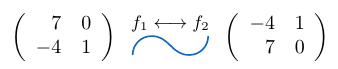
 e intercambiemos la fila
  , entonces,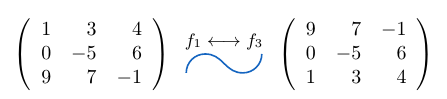
 e intercambiemos la fila
 e intercambiemos la fila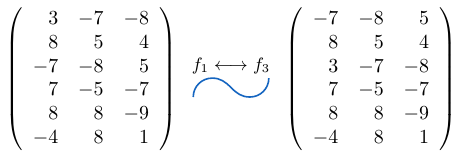
 y la expresamos de la siguiente manera:



 es igual a
  .
. le sumamos la fila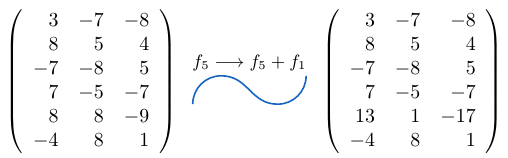
 es igual a
  .
. , para esto usamos la notación
  y la expresamos de la siguiente manera: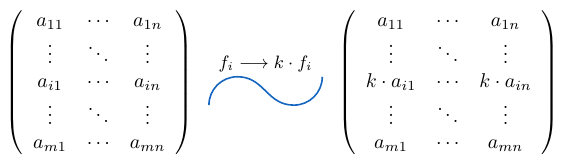

 , entonces,
 , entonces,
 , entonces,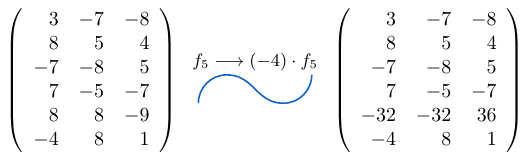
 y la expresamos de la siguiente manera: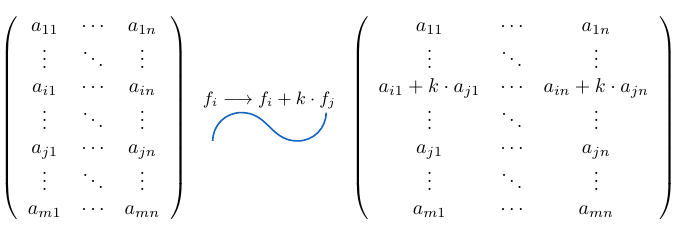



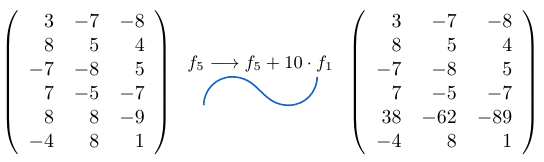
 se obtiene a partir de una matriz
 .
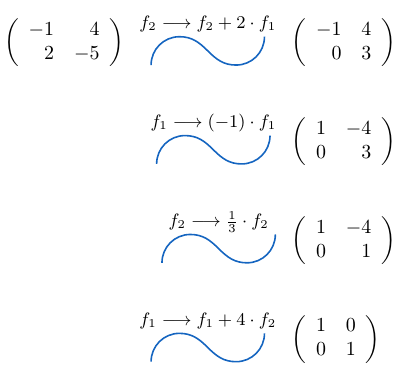
.
 y la expresamos de la siguiente manera: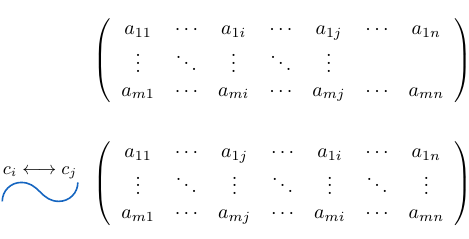


 y la expresamos de la siguiente manera: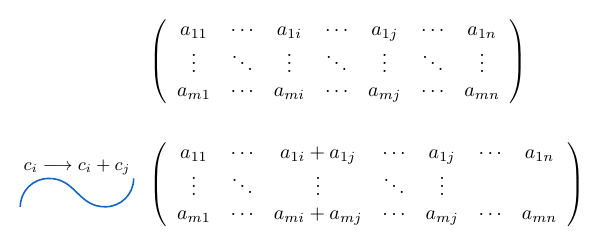




 y la expresamos de la siguiente manera: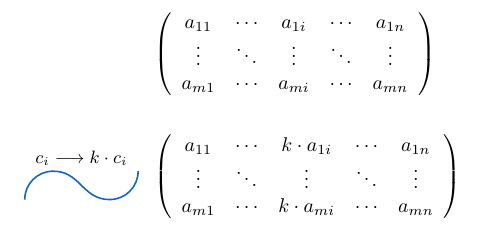


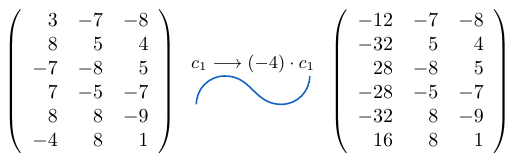
 y la expresamos de la siguiente manera: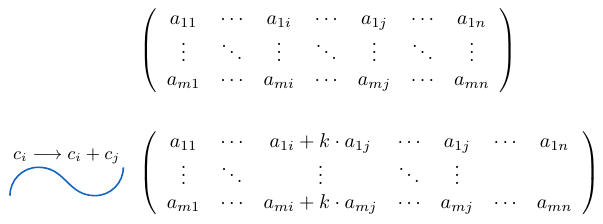



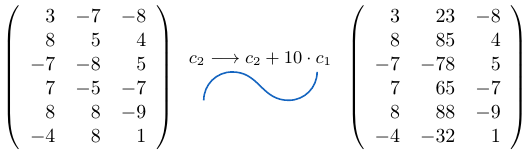
 or to denote half of a cake we simply write
  . It is possible to represent the fractions graphically to make them easier to understand.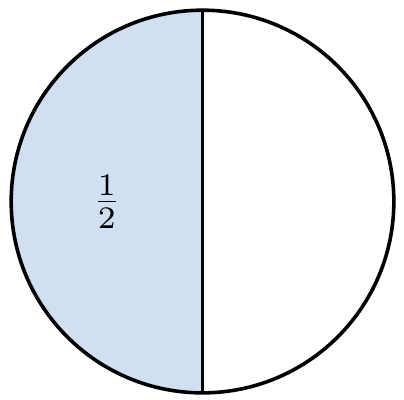
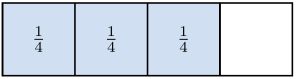
 and
and  , then we will say that
  is the denominator of the fraction, and so, the division
  will be represented by the following expression
 .
. .
. .
.

 .
. .
. .
. .
. , we will say that the fraction is
  , we will say that the fraction is
  , is an proper fraction, because its numerator is smaller than its denominator.
 , is an proper fraction, because its numerator is smaller than its denominator.
 , is an proper fraction, because its numerator is smaller than its denominator.
 , is an improper fraction, because its numerator is greater than its denominator.
 , is an improper fraction, because its numerator is bigger than its denominator.
 , is an improper fraction, because its numerator is bigger than its denominator.
 , is an improper fraction, because its numerator is bigger than its denominator.
 ,
,  or
or  . This also occurs when buying foods that must be weighed, such as one kilograms and a quarter cheese or three and a half kilograms of meat.
 which in turn is equal to
  . However, the way they are written may not present comfort or clarity in practice, that is why the mixed fractions (or mixed numbers) are defined, then, that instead of writing
 are positive integers, then the following mixed fraction
 , that is,

 as an improper fraction.
 as an improper fraction.

 as an improper fraction.

 y relaciona dos números reales indicando que el primero es mayor que el segundo. Por ejemplo:
 , se lee diez es mayor que ocho.
 , se lee tres es mayor que menos nueve.
 , se lee menos quince es mayor que menos dieciséis.
 y relaciona dos números reales indicando que el primero es mayor que el segundo pero también dejando la posibilidad de que sean iguales. Por ejemplo:
 , se lee siete es mayor o igual que cuatro.
 , se lee diez es mayor o igual que menos siete.
 , se lee menos uno es mayor o igual que menos cuatro.
 , se lee tres es mayor o igual que tres.
 , se lee menos ocho es mayor o igual que menos ocho.
 y relaciona dos números reales indicando que el primero es menor que el segundo. Por ejemplo:
 , se lee dos es menor que 5.
 , se lee menos trece es menor que cero.
 , se lee menos seis es menor que menos dos.
 y relaciona dos números reales indicando que el primero es menor que el segundo pero también dejando la posibilidad de que sean iguales. Por ejemplo:
 , se lee diez es menor o igual que veinte.
 , se lee menos tres es menor o igual que catorce.
 , se lee menos veintidós es menor o igual que menos nueve.
 , se lee seis es menor o igual que seis.
  , se lee menos diez es menor o igual que menos diez.
 totumat
Debe estar conectado para enviar un comentario.